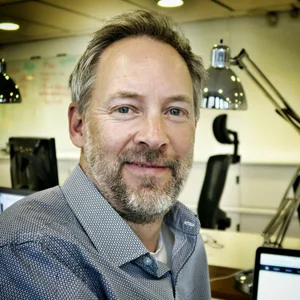
Alessandro Moro
RADIO FREQUENCY SPECIALIST
Taming the Stars: How a Radio Frequency Specialist is Bringing Fusion Energy Down to Earth
There is a particular kind of person drawn to fusion energy. Not simply scientists or engineers, but individuals comfortable living at the edge of the known — people willing to spend years wrestling with systems so complex they can seem almost alive. Alessandro Moro belongs firmly in that category.
As a Radio Frequency Specialist in the RF Wave Physics and Design team at Novatron Fusion Group (NFG), Moro works on one of fusion’s most delicate challenges: how to deliver immense amounts of electromagnetic power into a plasma hot enough to mimic the conditions inside a star. It is highly specialized work, sitting at the intersection of plasma physics, microwave engineering and systems design. Yet speaking with him, what emerges most clearly is not only technical depth, but perspective and the rare ability to see both the microscopic details and the wider mission.
Two Decades at the Extreme Edge of Physics
That perspective has been shaped over more than two decades spent inside some of Europe’s most advanced fusion research environments.
Before joining NFG, Moro spent almost 20 years at Istituto per la Scienza e Tecnologia dei Plasmi ISTP-CNR, one of Italy’s leading plasma science research institutes, contributing to plasma physics and fusion technology programs connected to major European collaborations and ITER-related development work.
Over the years, he participated in the design, optimization and operation of systems responsible for heating plasma using powerful microwave beams, contributing to both national experiments in Italy and wider European fusion programs. His work focused on Electron Cyclotron Resonance Heating (ECRH), a technology used to transfer microwave power into plasma with extreme precision.
The principle sounds deceptively simple. Electromagnetic waves are injected into plasma at a frequency that causes electrons to resonate, absorb energy and heat the plasma further. In practice, however, the challenge is extraordinary. Megawatts of microwave power must travel through precisely engineered transmission systems and couple efficiently into a plasma behaving in constantly shifting ways.
“You don’t want that energy going somewhere you don’t want,” Moro explains. “It needs to be absorbed by the plasma.”
It is this combination of physics, engineering and operational reality that defines his expertise. Across large international projects, including ITER-related collaborations lasting close to a decade, Moro gained experience not only designing systems but also operating them, an important distinction in fusion, where theoretical ambitions often collide with the practical realities of building reliable machines.
His work also brought him into leading European research environments, including time spent in Switzerland working with advanced tokamak experiments at the forefront of plasma research. Throughout those years, he remained closely connected to some of the most advanced microwave heating and plasma confinement programs in Europe.
“The physicist wants to make experiments,” he says with a smile. “And then reality comes in. You need to build things, operate them and make them reliable.”
Cosmic origins: Moro began his career in radio astronomy, analyzing faint signals from deep space using the exact same radio frequencies he now uses to heat plasma on Earth.
From Listening to Stars to Creating Them
That systems-level thinking is one of the qualities he now brings to NFG. In fusion, specialists are common. People who understand how every layer connects — from theory to hardware to operation — are considerably rarer.
Moro’s path into fusion was itself unconventional. Originally trained in astrophysics, his early work focused on radio astronomy, studying signals arriving from deep space using radio telescopes. The frequencies he worked with then are remarkably similar to the ones he uses today in fusion research.
“The difference is the power,” he says.
Where radio telescopes detect impossibly faint cosmic signals, fusion systems generate megawatts of microwave energy to heat plasma. The transition from observing the universe to recreating one of its core processes on Earth felt strangely natural.
“If you think about fusion and what it is in the universe, I think it’s the most amazing phenomenon you can imagine,” he reflects. “To realize on Earth something that happens in the stars — it’s fascinating.”
That sense of wonder still underpins his work, but it is balanced by realism. Having spent years inside large publicly funded research programs, Moro understands both their strengths and their limitations. He speaks respectfully about institutions like ITER, describing them as “elephants” — massive, slow-moving entities that ultimately clear pathways for everyone else.
“When they move, they make the road for all the other animals in the savannah,” he says.
Simplicity: The Key to Commercial Power
For Moro, private fusion companies now represent the next essential stage in the journey. Public institutions proved the science could work. The challenge today is turning fusion into something practical, scalable and deployable.
That urgency was one of the reasons NFG appealed to him.
After deciding to relocate from Milan to Munich to live with his wife, Moro was approached by NFG during his job search. The opportunity represented more than a career move. It was a shift in mindset. “What impressed me was the agility,” he says.
At NFG, he watched systems move from concept to operation in less than a year — timelines virtually impossible in traditional research institutions constrained by layers of approvals and funding structures. But importantly, he also saw a company deeply respectful of scientific expertise and academic knowledge rather than attempting to reinvent everything from scratch. That balance resonated with him.
“I liked that NFG relies on competencies and experience coming from academia,” he says.
Today, working between Munich and Stockholm, Moro contributes to the development of NFG’s heating systems and plasma modelling capabilities, supporting both experimental planning and conceptual design work for future machines. His work spans simulations, electromagnetic modelling, systems integration and supplier development — a role requiring broad technical fluency and careful coordination across disciplines.
It also aligns naturally with NFG’s broader philosophy.
Unlike many fusion approaches centered on highly complex magnetic geometries, NFG is pursuing a mirror-based confinement concept built around simplicity and maintainability. Moro believes this could become one of the company’s defining advantages.
“We don’t want to be just the first one,” he says. “We want to be the best one.”
“If you think about fusion and what it is in the universe, I think it’s the most amazing phenomenon you can imagine,” he reflects. “To realize on Earth something that happens in the stars — it’s fascinating.”
Bridging the Gap to Tomorrow
For him, the future of fusion cannot rely on systems so intricate they become impractical to operate commercially. A viable power plant must eventually function like real infrastructure — maintainable, serviceable and dependable.
“You need to switch it on and switch it off,” he says plainly.
That practicality reflects Moro’s own personality: deeply scientific, yet grounded. Even when discussing some of physics’ most abstract problems, he returns repeatedly to implementation, usability and long-term impact.
Colleagues also benefit from his international perspective. Based primarily in Munich while travelling regularly to Stockholm, Moro operated across multiple European fusion ecosystems. He sees growing momentum in Germany particularly, where strong political backing and close public-private collaboration are accelerating investment in fusion technologies.
Yet despite the scale of the challenge, Moro remains notably optimistic.
“Now, with private players, we’re closer than ever before.”
A curious mind
Outside work, Moro balances the intensity of fusion research with a passion for travel and exploration — something made easier by life in Munich and his continued connections to Milan and northern Italy.
Curiosity, it seems, is not confined to the laboratory. That curiosity may ultimately be what defines him best.
From radio astronomy to plasma heating, from listening to signals from distant stars to helping recreate stellar processes on Earth, Moro’s career traces an unusually elegant arc. It is a journey shaped by patience, precision and an enduring fascination with how the universe works.
At NFG, those qualities matter enormously. Fusion may depend on breakthrough technologies, but it is equally driven by people capable of bridging disciplines, translating theory into reality and keeping sight of the bigger picture through years of complexity.
People like Alessandro Moro.